XERF: a monopolar radiofrequency platform, and what is actually known about it
XERF is a monopolar radiofrequency device made by Lutronic, a Korean manufacturer. Its distinguishing design feature is that it runs two frequencies, 6.78 MHz and 2 MHz, rather than one. The most useful part of this page, though, is not the specification list but how far the evidence has actually come. Three studies in humans using this device have appeared (20 · 39 · 16 people) and none of the three has a control group. The other five are preclinical studies funded by the manufacturer. This page keeps that distinction visible rather than blurring it.
In one paragraph
XERF is a monopolar radiofrequency (RF) lifting device manufactured by Lutronic Corporation in Goyang, Gyeonggi Province, South Korea. It passes a radiofrequency current through the skin to generate heat in the dermis and the layers beneath it. That heat contracts existing collagen fibres and triggers a wound-healing response that lays down new collagen over the following weeks. XERF combines two frequencies — 6.78 MHz and 2 MHz — with four handpieces of differing contact area, so that different regions of the face can be treated differently. Where injectable treatments work on the material inside the dermis, a device like this works on the structure below it.
At a glance
| Category | Non-invasive radiofrequency lifting device |
|---|---|
| Mode | Monopolar RF |
| Frequencies | 6.78 MHz · 2 MHz |
| Handpieces | Four (XERF i05, i10; EFFECTOR E40, E60) |
| Manufacturer | Lutronic Corporation, Goyang, South Korea |
| Regulatory status | Approved as a medical device by Korea's MFDS — we could not find a published approval number |
| Approved device class | General-purpose electrosurgical unit |
| Anaesthesia | Usually none; topical anaesthetic where needed |
| Downtime | Most patients return to normal activity the same day |
| Targets | Skin laxity, softening jawline and cheeks, skin texture |
| Does not treat | Volume loss, advanced laxity, pigmentary conditions |
| Published data in humans | Three studies (20 · 39 · 16 people) — two prospective · one retrospective, none with a control group |
What radiofrequency actually does to skin
Radiofrequency is not light. A laser works by being absorbed — by pigment, by water, by haemoglobin — and destroying a chosen target. RF instead pushes an alternating electrical current through tissue; charged molecules reverse direction with the current, and the friction produces heat. Because nothing is absorbing light, the constraints skin colour places on laser treatment apply much less here.
The heat is the whole point. Once tissue reaches a particular temperature range, collagen fibres partially unwind and contract immediately — what some patients feel as tightness on the day. Separately, the thermal insult switches on a repair response, and over the following weeks fibroblasts deposit new collagen. This is why radiofrequency treatments are assessed at two to three months, not on the day.
Monopolar and bipolar RF differ in where that heat ends up. In a bipolar device the current travels between two closely spaced electrodes, so energy stays relatively superficial. In a monopolar device the current leaves the handpiece, passes through the body and returns through a separate electrode placed elsewhere, travelling through a larger and deeper volume of tissue. Devices built for lifting are generally monopolar for that reason.
Injections and devices work on different layers
A question that comes up in almost every consultation is whether to have a skin booster or a lifting treatment, as though the two were alternatives. They are not really competing, because they address different layers. Injectable boosters place material into the dermis or alter how it behaves, targeting density and texture. Radiofrequency puts heat into the deeper structural layer and targets a contour that has begun to descend. So a patient whose skin is thin but whose contour is intact will be disappointed by lifting alone, and the reverse holds too.
Injections work on the material in the dermis and devices work on the structure below it — which means the useful question is not which is better, but whether the two can be planned together. Our comparison of collagen and skin boosters covers the injectable side; our other RF platforms are documented under Density and Oligio Kiss.
How XERF is configured — two frequencies, four handpieces
XERF does not use a single frequency. It operates at 6.78 MHz and at 2 MHz. In radiofrequency generally, frequency influences how current distributes through tissue: lower frequencies tend to spread more deeply, higher frequencies tend to concentrate energy more superficially. The manufacturer describes the combination of these two frequencies as addressing three tiers of depth — superficial, intermediate and deep.
The four handpieces differ in contact area and maximum shot count. In practice the deciding question is whether a given tip can sit flat against a given part of the face. A large tip on a narrow, curved area makes poor contact; a small tip dragged across a broad cheek takes longer and delivers energy less evenly.
| Handpiece | Contact area | Max shots | Typical use |
|---|---|---|---|
| XERF i05 | 5 × 10 mm | 400 | Narrow, thin areas — used around the eyes at Miso Clinic (eye XERF) |
| XERF i10 | 10 × 10 mm | 300 | Small, contoured areas |
| EFFECTOR E40 | 20 × 20 mm | 600 | General full-face use |
| EFFECTOR E60 | 20 × 30 mm | 600 | Broad, thicker areas |
These figures are the manufacturer's published specifications. How many shots a given treatment uses depends on the area covered and the condition of the skin; a higher shot count is not in itself a better treatment.
Who this suits, and who it does not
Reasonable candidates
- Early to moderate laxity — a jawline losing definition, cheeks that sit lower than they did
- Patients who do not want surgery and cannot afford visible downtime
- Patients wanting firmness and texture addressed in the same session
- Patients uncomfortable with needle-based treatments
- Patients already treating the dermis with injectables whose contour has not changed
Where XERF alone will not get you there
- Hollow cheeks or temples — radiofrequency creates no volume
- Advanced laxity with actual folding of skin — that is surgical territory
- Thin, depleted dermis — injectables that supply material come first
- Melasma, redness or pore concerns as the principal complaint
- An implanted electronic device — pacemaker, implantable defibrillator — in which case RF is contraindicated as a rule
- Pregnancy, or active infection or broken skin at the treatment site
- Metal implants or substantial filler in the treatment area — tell us beforehand
How good is the evidence
This is the section that matters most, so it is set out in three parts.
1. Evidence for XERF specifically
Three studies in humans using XERF have been published so far — 20 women in 2025 (one session · 12 weeks · single centre), 39 people in 2026 (four centres · two sessions · 90 days), and 16 women in 2026 (retrospective · one session · three months). None of the three has a control group, and there is still not one randomised controlled trial. In the 39-person study the manufacturer supplied the device and research support, and the assessment was scored by the treating investigator himself without blinding. Beyond that there are five preclinical studies in pigs · artificial skin, but their authors are employed by the manufacturer or the work was company-funded. So what can be said at present is "the material has begun to accumulate" and not "it is clinically proven". The design and limits of each piece of that material are set out in how far the evidence for XERF has come and looking into XERF in Daegu.
2. The regulatory facts
XERF is approved as a medical device by Korea's Ministry of Food and Drug Safety (MFDS). Two points need stating precisely.
First, we could not find a published approval number. The number the manufacturer publishes is an advertising pre-review number — "General-purpose electrosurgical unit combination-2024-16-054", valid to 22 April 2027. An advertising review number is not an approval number. Korea requires medical advertising to be pre-screened; that screening examines the wording of the advertisement, while device approval examines the safety and performance of the device itself. Presenting the former as though it were the latter is not accurate.
Second, as that number shows, the approved device class is "general-purpose electrosurgical unit." The product is sold as a lifting device, but its regulatory category is a broad one covering equipment that delivers RF energy to tissue. It is not an individual finding about facial lifting. Patients should know that before choosing.
3. Evidence for monopolar radiofrequency as a class
The material on XERF itself is still thin, but there is more research on monopolar radiofrequency generally. It was not conducted with XERF, and its findings should not be transferred to XERF as though they were. We cite it here with that attribution made explicit.
Cosmetics 2024;11(3):71 reported on 20 healthy women (mean age 47.95±6.02, Fitzpatrick skin types III–IV, mild to moderate facial laxity) assessed at 4, 12 and 24 weeks after a single monopolar RF treatment. Reported findings:
- Statistically significant improvement in the jawline and nasolabial folds at 12 weeks (p<0.05)
- Increased cheek elasticity from week 4 (p<0.01), sustained to 24 weeks
- Mean pain during treatment of 0.4 out of 10
- No burns or scarring reported
Read alone, those are encouraging numbers. They should be read alongside the limitations the authors state themselves:
- No randomised control group — this was a prospective, evaluator-blinded cohort study
- Twenty participants, all female — too small and too narrow to generalise from
- No comparison against other anti-ageing technologies — so it supports no claim of superiority over anything
Put together: monopolar radiofrequency as an approach has small but consistent supporting evidence, and for XERF as an individual device the material in humans has now grown to three studies. None of the three, though, has a control group. We use XERF not because it is "clinically proven" — it would be untrue to say so — but because the mechanism of the class is well established and the range of handpiece sizes is genuinely useful across different regions of a face. We have no grounds to claim more.
Miso Clinic, Daegu — XERF ambassador
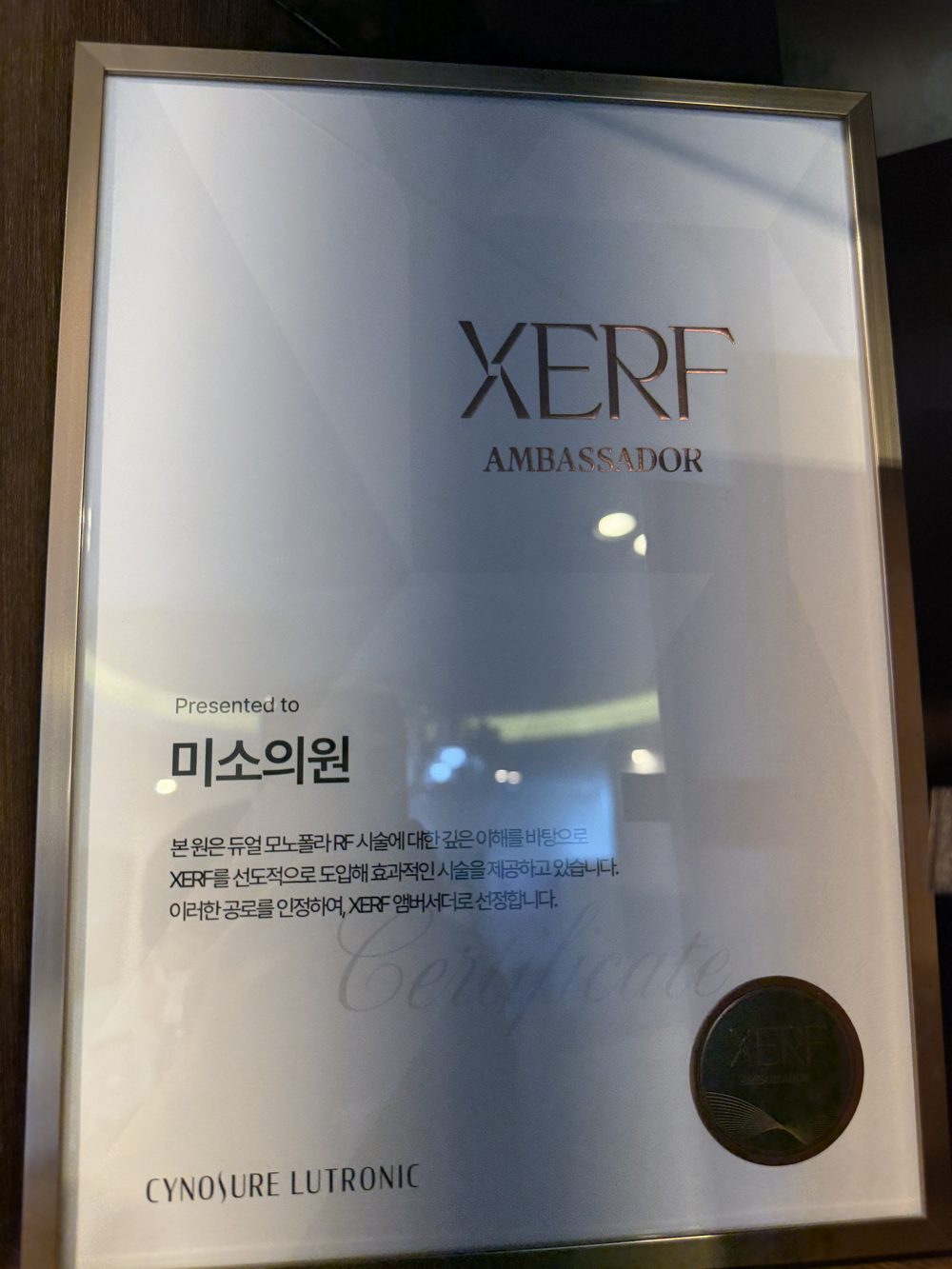
Miso Clinic in Daegu has been selected as a XERF ambassador by Cynosure Lutronic, the maker of XERF. The certificate recognises that we adopted and perform XERF on the basis of an understanding of dual monopolar RF.
- We have all four XERF effectors (i05, i10, E40 and E60) and choose between them by site.
- Around the eyes we use the i05 effector (5 × 10 mm, 400 shots) — what the market calls “eye XERF”. We usually continue the eyes from a full-face plan.
What the appointment involves
The consultation starts by identifying which layer the visible change belongs to. If laxity dominates, radiofrequency is appropriate; if the dermis is thin and the texture poor, injectables come first. Both often apply, in which case we sequence them rather than combining everything into one visit.
Because RF passes current through the body, some history must be established before treatment. Please tell us about implanted electronic devices (pacemaker, defibrillator), metal implants, any filler or thread placement in the area, pregnancy, and skin disease. This is not a formality.
The session itself: the face is cleansed of makeup and oil, and a return electrode pad is placed so the current has a path back. Gel is applied to aid conduction and cooling, treatment zones are marked, and the handpieces are worked through in order — smaller tips for narrow regions, larger for broad ones. A full face takes roughly 40 minutes to an hour including preparation.
Power is not set to maximum at the start. We begin low and adjust against the heat you report feeling. If something feels hot rather than warm, say so immediately — that feedback is what the power setting is calibrated against.
Timeline
-
Same dayRedness and warmthTreated areas look flushed and feel warm. Some patients notice tightness — that is immediate collagen contraction, and it is not the final result.
-
Day 1–3Mostly settledErythema usually clears within hours to a day; any swelling or pressure marks resolve within a few days.
-
Week 2–4The ambiguous stretchImmediate tightening has faded and new collagen is not yet substantial. It is too early to conclude the treatment did nothing.
-
Month 2–3Assessment pointRemodelling has accumulated. We compare against pre-treatment photographs and discuss what, if anything, comes next.
-
BeyondObservationWe have no data supporting a specific duration figure, so any repeat is decided on what we observe. Ageing continues; treatment does not freeze a point in time.
Pain, downtime and adverse effects
Pain — the usual sensation is repeated warmth building to brief moments of heat. The class study cited above reported mean intra-procedural pain of 0.4/10, but that figure belongs to that study's conditions; what you feel depends heavily on power settings and individual sensitivity. Areas close to bone — forehead, jawline, temples — tend to register more sharply.
Downtime — most patients return to normal activity the same day. Redness immediately afterwards may not be fully concealable with makeup, so allow some margin if you have something important that evening.
For the first few days
- Cleanse gently with lukewarm water; do not rub the treated skin
- Avoid sauna, jjimjilbang, strenuous exercise and alcohol on the day
- Moisturise well and use sun protection diligently
- Postpone exfoliants and actives for several days
- Return to the clinic promptly if you notice unusual sensation or persistent pain
Common questions
Is Miso Clinic a XERF ambassador?
Has XERF been shown to work in a clinical trial?
Is it an approved device? What is the approval number?
Does using 6.78 MHz and 2 MHz together reach deeper?
How many sessions, and how long does it last?
Does it hurt? Will I need anaesthetic?
Can it be done over areas with filler or threads?
Should I do injectables or radiofrequency first?
What does it cost?
Column — Density vs XERF in Daegu: results, differences and who each suits →
Column — Choosing between Density and XERF in Daegu: what to check →
Column — Sagging or loss of firmness: is Density or XERF the better fit? →
About the authoring clinic
This reference was written and reviewed by Dr. Lee Chi-Hak, director of Miso Clinic in Daegu, South Korea. Alongside XERF the clinic operates two other radiofrequency platforms — Density and Oligio Kiss — and separately stocks collagen and skin boosters that work on the dermis. Holding several devices is not a claim that any one is superior; it is that a clinic with a single device ends up using it on every face. Our other references are collected in the Miso Clinic reference library.
| Director | Dr. Lee Chi-Hak |
|---|---|
| Address | 4F Bombom Building, 125 Dongdeok-ro, Jung-gu, Daegu, South Korea · Exit 1, Kyungpook National University Hospital Station |
| Telephone | +82 53-428-2700 |
| Hours | Weekdays 11:00–19:00 (lunch 13:00–14:00) / Saturday 10:00–16:00 (no lunch break) / Closed Sundays and public holidays |
| Website | clinicmiso.co.kr |
| Reference library | Miso Clinic reference library |
Density and XERF in Daegu: columns to read next
- XERF lifting in Daegu: which skin it suits — a map of 12 XERF columns
- XERF lifting in Daegu — everything to know before treatment, in one place
- Density lifting in Daegu — everything to know before treatment, in one place
- How long do Density and XERF last? — how to decide when to retreat
- Density and XERF side effects and burns — how rare they are, and what to watch for when
- Why do some reviews say Density or XERF “did nothing”?
- Ulthera and Thermage vs Density and XERF — what is the same and what is different
- Do Density and XERF reduce cheek fat or a double chin?
- What age should you start Density or XERF? — what matters more than age
- Density and XERF for men — can women’s data guide the decision?
- The first three months after Density or XERF — swelling, make-up, exercise and when to judge
References
- Suh D·H et al. Efficacy and Safety of Monopolar Radiofrequency for Tightening the Skin of Aged Faces. Cosmetics 2024;11(3):71. Twenty healthy women (mean age 47.95±6.02, Fitzpatrick III–IV) assessed at 4, 12 and 24 weeks after a single treatment. A prospective, evaluator-blinded cohort study without a randomised control group; the authors state as limitations the absence of randomised controls, the small all-female sample, and the lack of comparison with other anti-ageing technologies. Not a study of XERF — evidence for monopolar radiofrequency as a class.
- XERF product information, Lutronic Corporation. Source for the frequency configuration, handpiece specifications, and the manufacturer's account of treatment depth.
- Korean medical device advertising pre-review marking — "General-purpose electrosurgical unit combination-2024-16-054", valid to 22 April 2027. A pre-review of advertising wording; not an approval number.
- General literature on radiofrequency tissue heating and thermal collagen contraction — current paths in monopolar versus bipolar configurations, thermally induced changes in collagen structure, and subsequent neocollagenesis.
- Miso Clinic protocol — pre-treatment contraindication screening, handpiece selection by region, power titration, and informed-consent procedure.
A lighter read on this topic — What Is XERF? Why Some People Choose It Over Thermage
This page provides general information about an aesthetic treatment and does not substitute for medical diagnosis or care. Outcomes and adverse effects vary with individual skin condition, age and underlying illness, and no result is guaranteed. Decisions about treatment should be made in an in-person consultation with a qualified clinician.
한국어 · English · 日本語 · 简体中文 · Español · Tiếng Việt · ภาษาไทย · Bahasa Indonesia