Re2O in Daegu: how we prepare it just before treatment — the steps in photos
Patients often ask us what Re2O actually looks like, and whether one syringe is shared between several people. It all happens in the treatment room, so you never get to see it. Here we show, in photos, how Re2O is prepared at Miso Clinic. Which skin it suits is covered in Re2O in Daegu: which skin it suits, and what to settle at the consultation in Re2O (hADM): what to settle before the name. This page covers preparation only. No prices or testimonials.
The short answer
Re2O comes as a white powder inside a syringe, so it is mixed with liquid just before treatment. At Miso Clinic we first dissolve the powder with saline, then add hyaluronic acid (Elravie Balance 1.5 mL), making about 6 cc in total. And one Re2O syringe is used for one patient only. This volume and order are our own clinic standard — we could not find a dilution volume published by the manufacturer.
Why does Re2O have to be mixed?
Re2O is a dermal matrix (hADM) made from donated human skin: the cells and DNA are removed and only structural components such as collagen and elastin remain. It is freeze-dried into a powder and supplied in a syringe.
Unlike a hyaluronic acid filler, it is not a gel to begin with, so it cannot be injected as it is. It is mixed with liquid just before treatment to make it injectable.
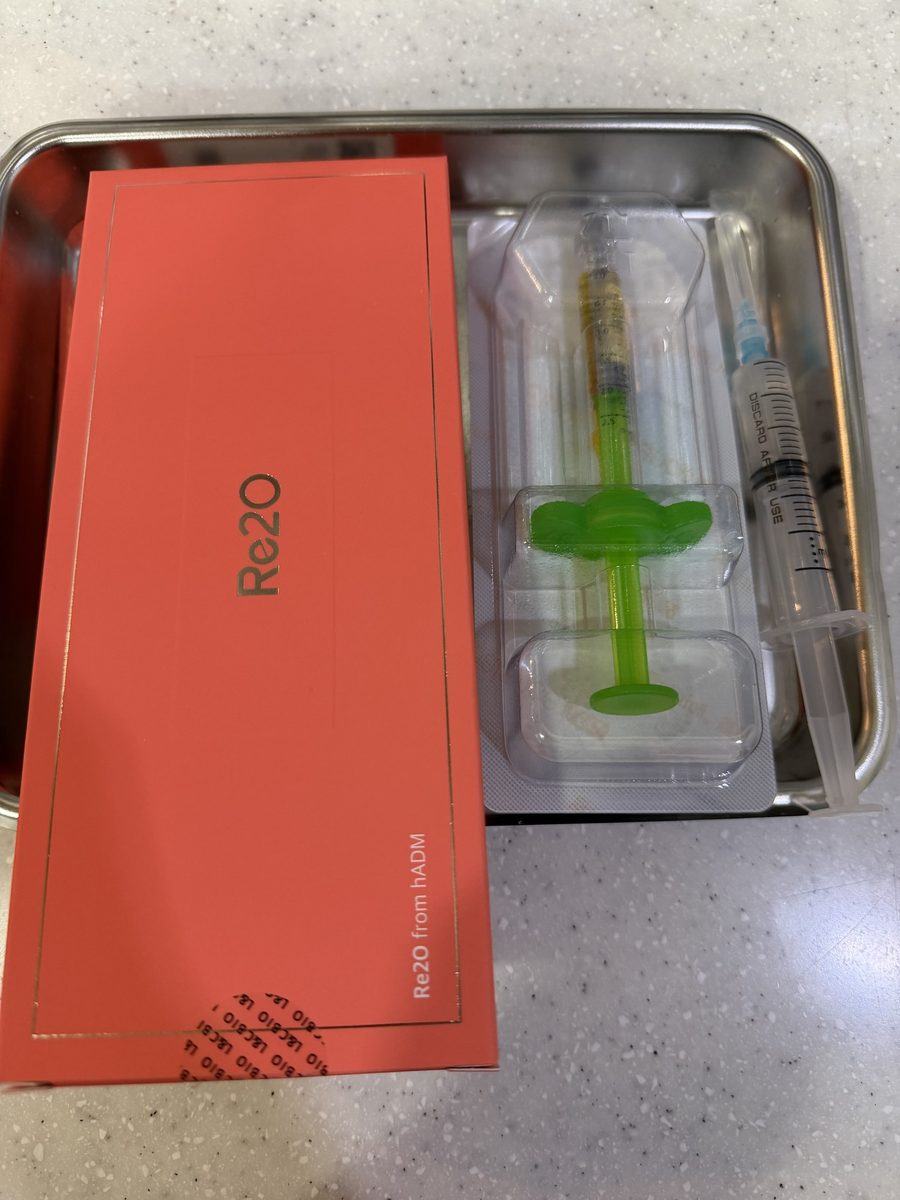
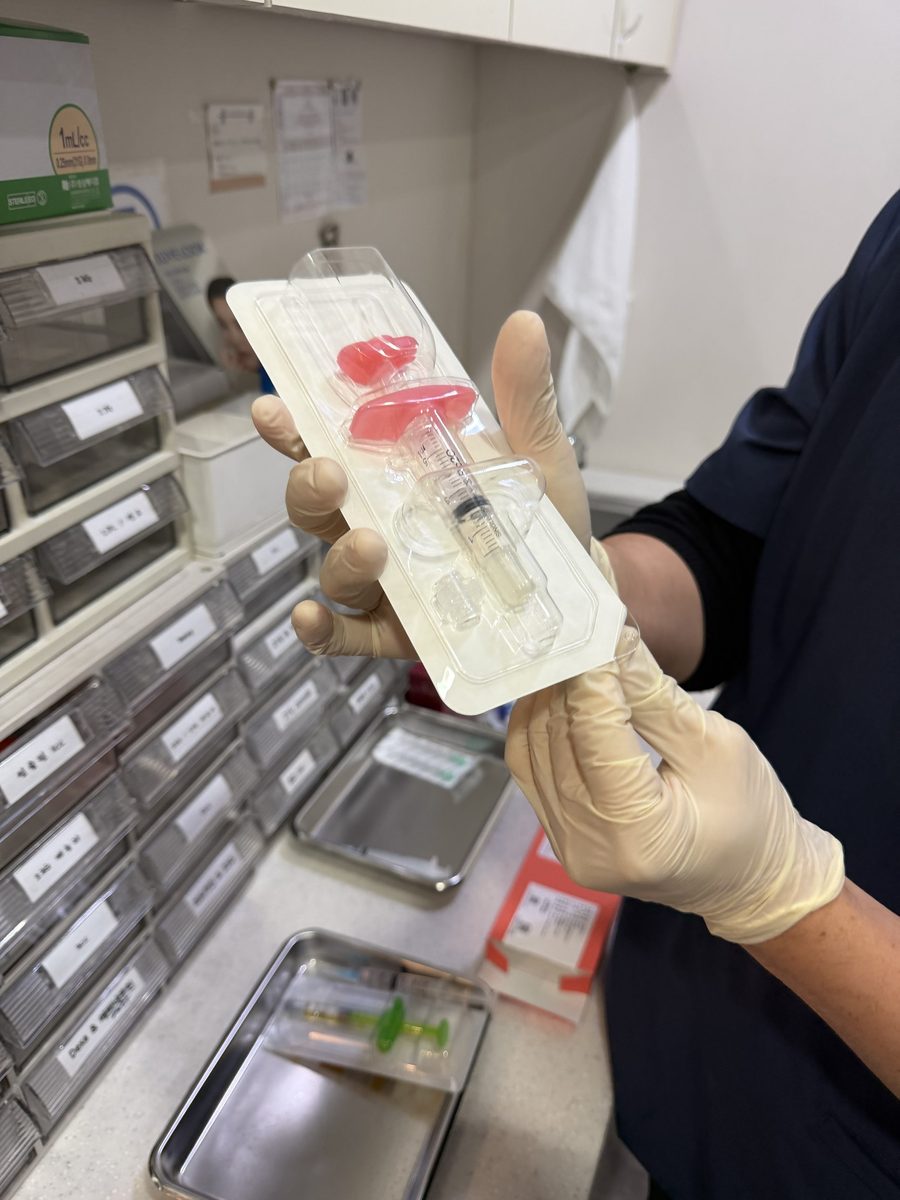
What do we prepare?
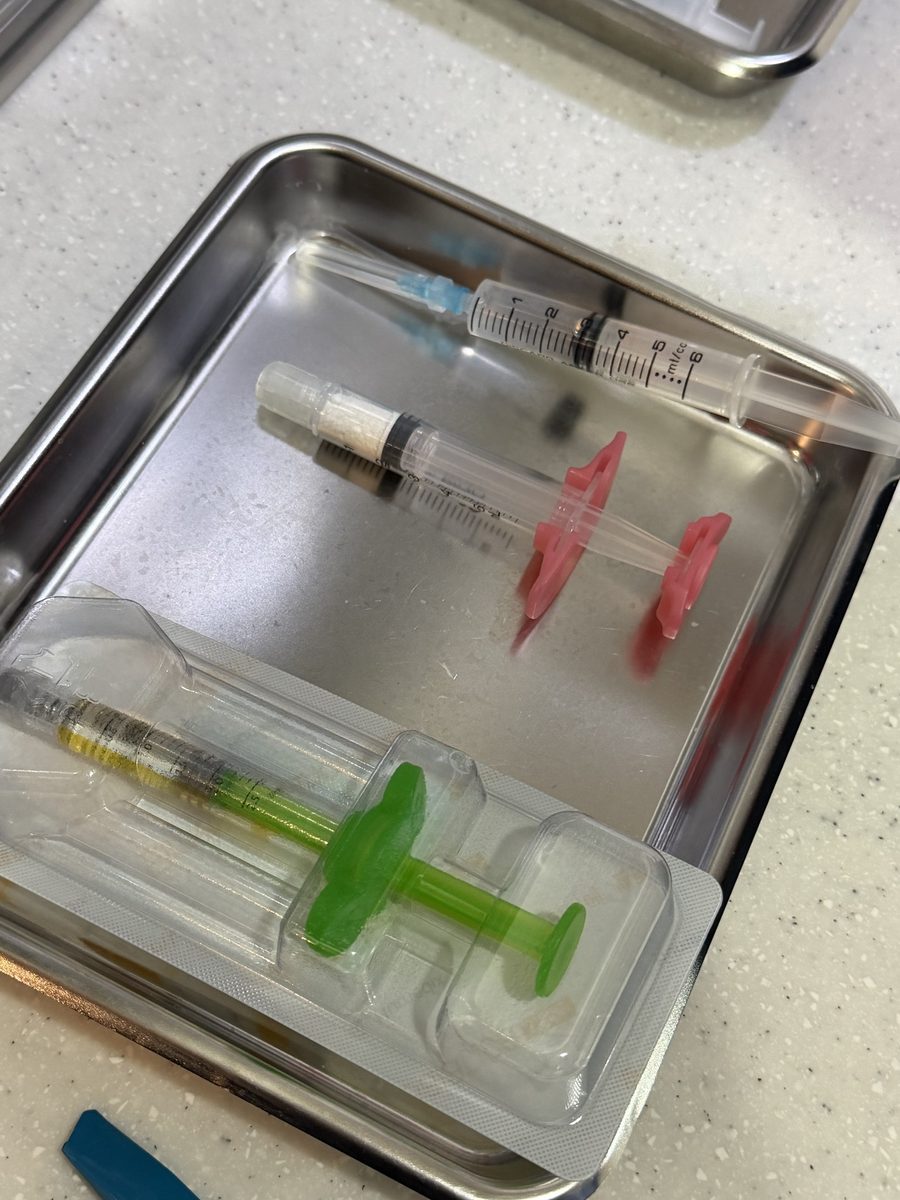
- The syringe containing Re2O powder
- Saline
- Hyaluronic acid (Elravie Balance 1.5 mL)
- A connector that joins two syringes
We normally use a two-way connector. When a larger amount of local anaesthetic (lidocaine) is mixed in to reduce pain, we use a three-way connector. The photos below show a three-way connection.
In what order is it mixed?
1. Dissolve the powder with saline. The two syringes are joined with the connector, the liquid is pushed into the powder side, and the contents are passed back and forth until evenly dissolved with no lumps.
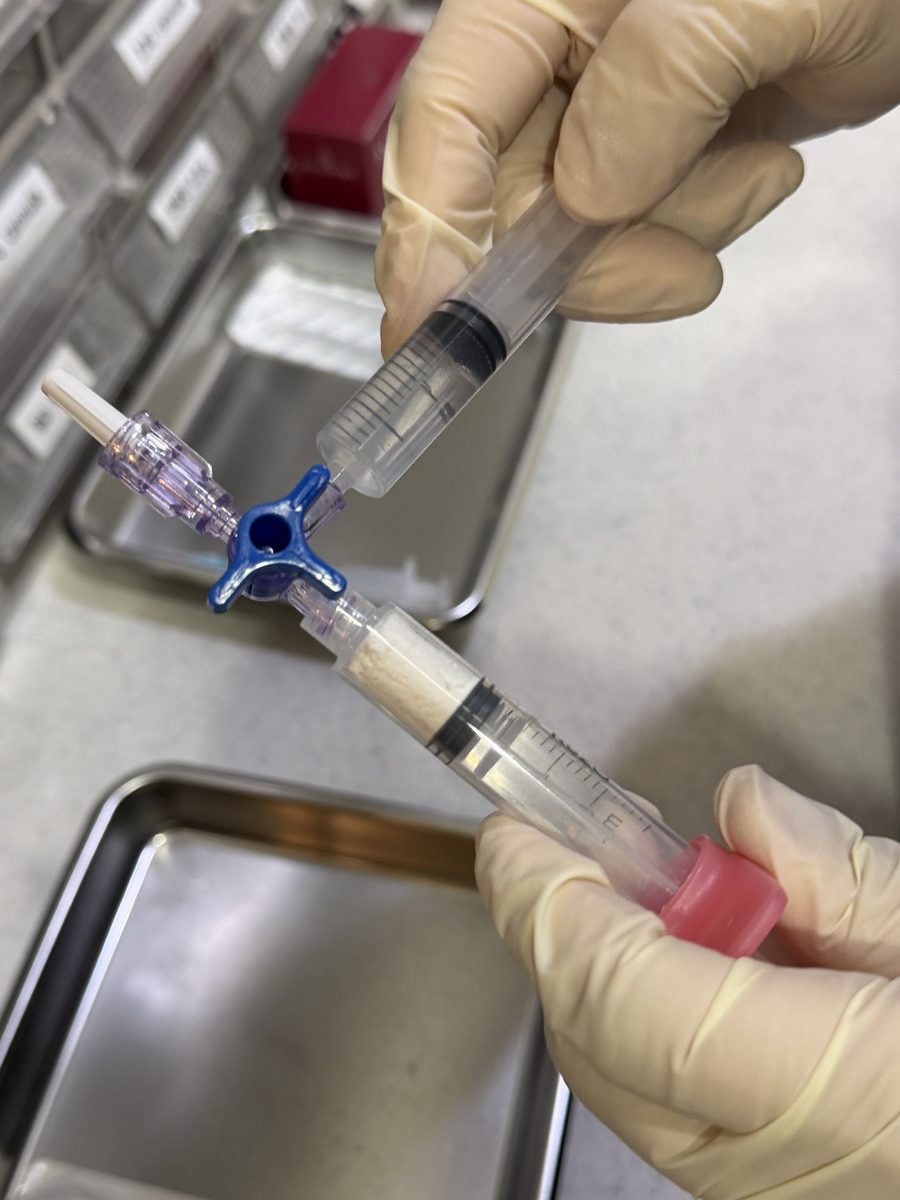
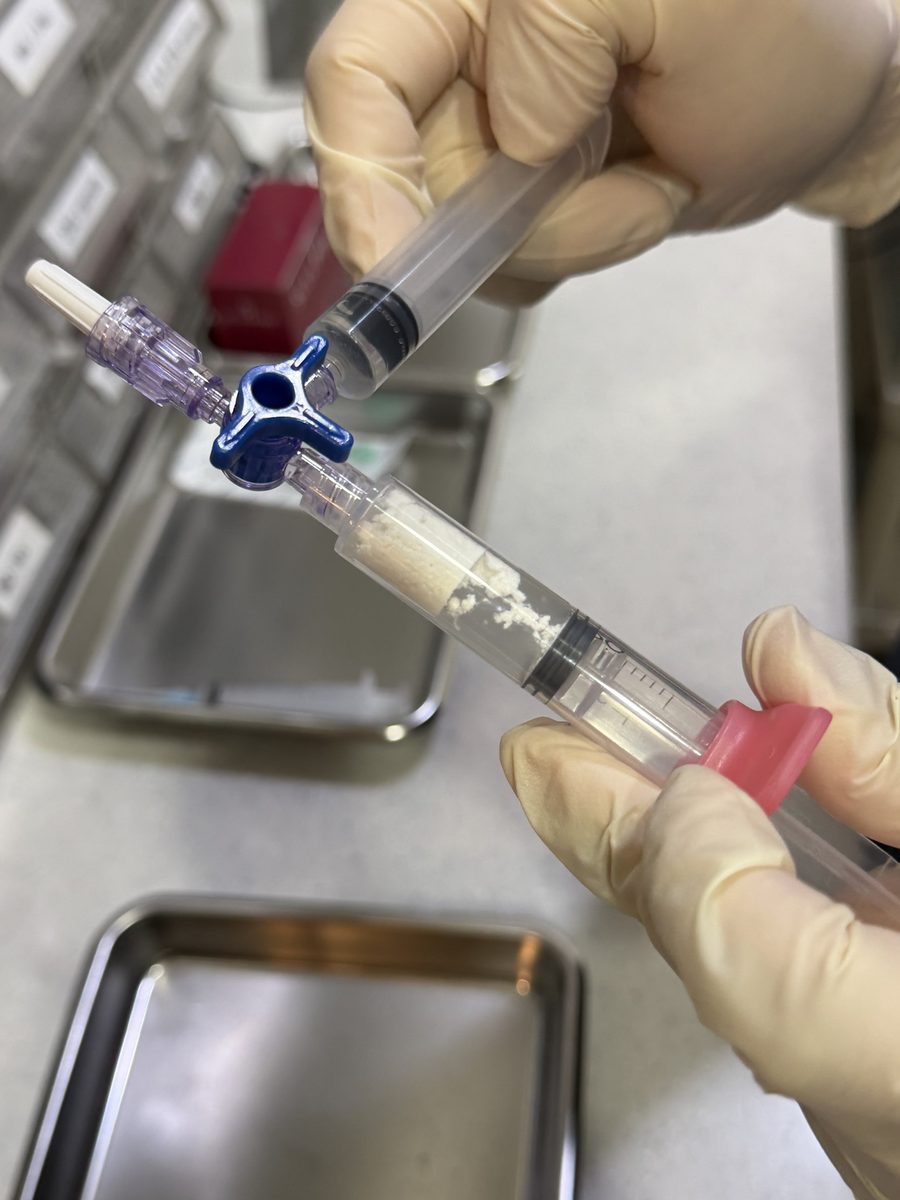
2. Add hyaluronic acid and mix again. Elravie Balance is added to the dissolved Re2O and mixed the same way. Once fully mixed, it turns milky white.
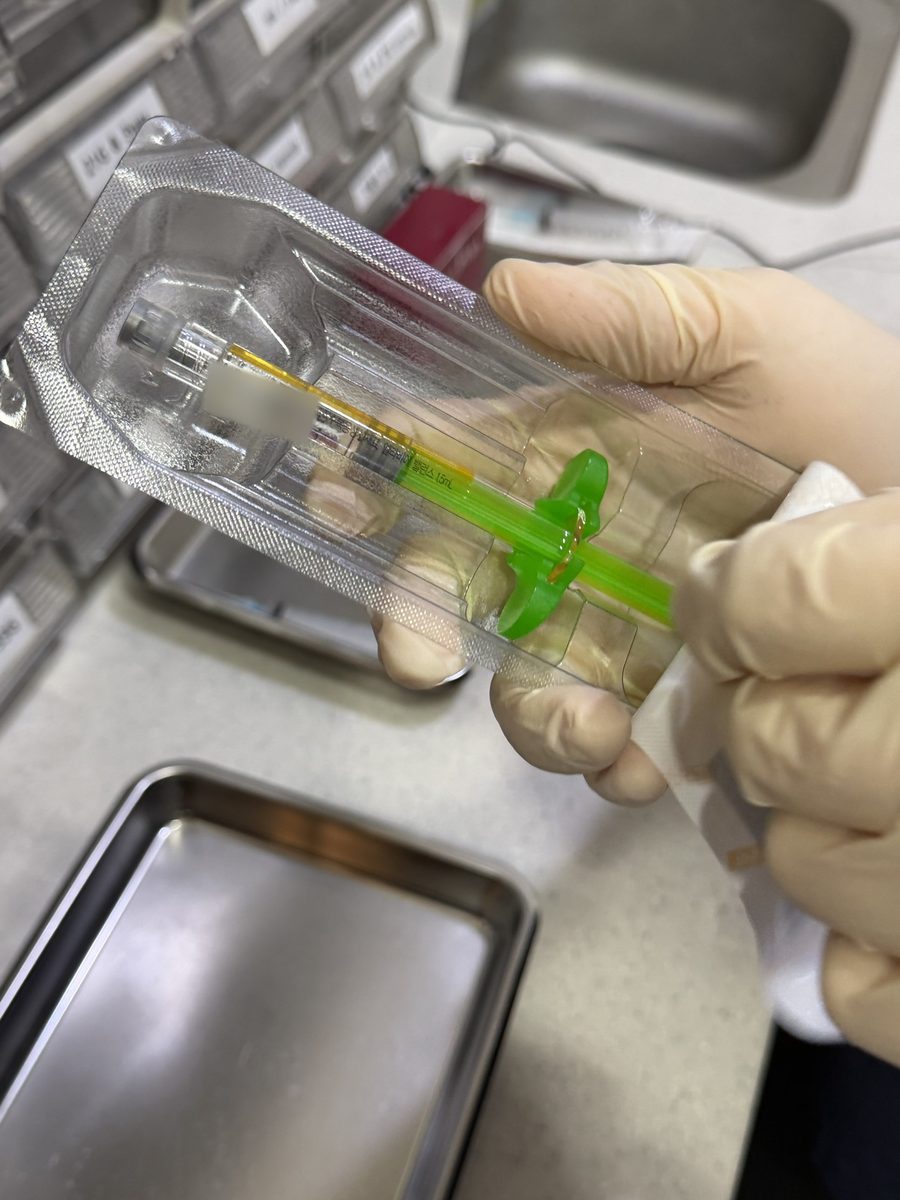
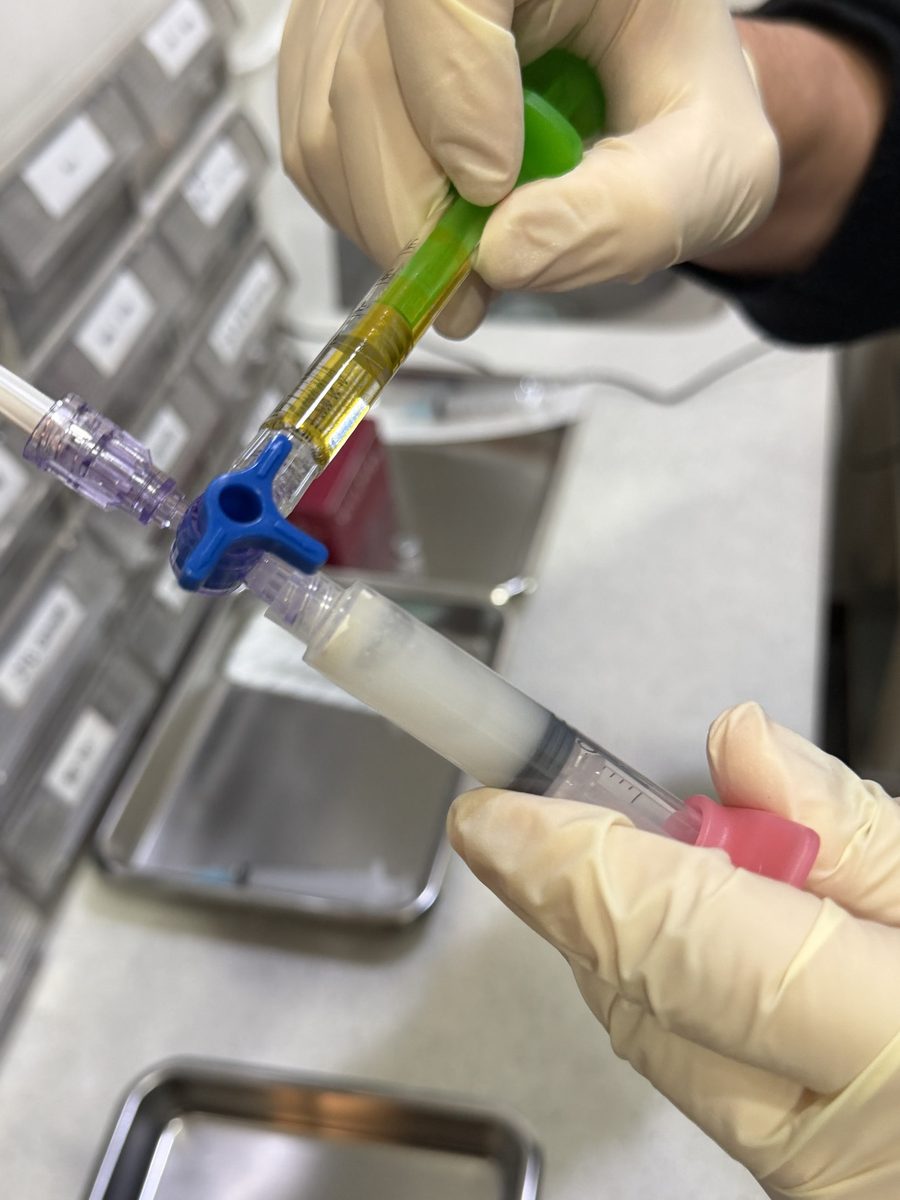
3. The final volume is about 6 cc. All the liquids together come to roughly 6 cc. This is Miso Clinic’s standard and may differ between clinics.
Why add hyaluronic acid?
To help the Re2O particles spread evenly and pass smoothly during injection. Our reasoning is that it keeps the mixture uniform in the syringe and helps it go evenly into the skin through a needle or cannula.
We could not find any human study comparing Re2O mixed with and without hyaluronic acid. This is a choice based on our treatment experience, and we say so plainly.
One syringe, one patient
At Miso Clinic one Re2O syringe is used for one patient only. A syringe opened for you is used only for your treatment and is never shared with anyone else.
Dividing an opened sterile product between several people creates chances for contamination. So this is not a choice that changes case by case; it is a rule we keep.
What this page does not cover
- Whether the dilution changes the result — we could not find a human study comparing different dilution volumes or mixing liquids for Re2O.
- The manufacturer’s standard preparation — the manufacturer announced an advisory board in August 2026 to set injection standards; we have not seen a published standard document yet.
- How much goes where — how the prepared volume is divided depends on the area and skin thickness. That is covered in Re2O in Daegu: layering in the dermis.
Whether Re2O suits you depends on the state of your skin, not on the product. We check that together at the consultation.
Re2O preparation: frequently asked questions
Is one Re2O syringe ever shared between two people?
At Miso Clinic one Re2O syringe is used for one patient only. A syringe opened for you is used only for your treatment and is not shared.
How much is Re2O diluted?
We dissolve the powder with saline and add hyaluronic acid (Elravie Balance 1.5 mL), making about 6 cc in total. This is our clinic standard; we could not find a dilution volume published by the manufacturer.
Does more dilution make it weaker?
We could not find a human study comparing results by dilution volume for Re2O. So at the consultation we focus less on how many cc and more on which layer and how many points it is divided into.
Why is hyaluronic acid added?
To help the Re2O particles spread evenly and inject smoothly. We could not find a human study comparing mixing with and without it; it is a choice based on our treatment experience.
Read next
Product pages
Product pages: Re2O (Rituo) · Collagen boosters at Miso Clinic
Who wrote this
Written and reviewed by Lee Chi-Hak, MD, director of Miso Clinic, Daegu. The treatment standards and injection design set out here are the ones we use in practice.
| Medical director | Lee Chi-Hak, MD |
|---|---|
| Address | 4F Bombom Building, 125 Dongdeok-ro, Jung-gu, Daegu, South Korea · Exit 1, Kyungpook National University Hospital Station |
| Phone | +82-53-428-2700 |
| Hours | Weekdays 11:00–19:00 (lunch 13:00–14:00) / Saturday 10:00–16:00 (no lunch break) / Closed Sundays and public holidays |
| Columns | All clinical columns |
| Reference library | All booster and device references |
References
- Randomised human trial of Re2O — Lee YI et al. Int J Mol Sci 2026;27(5):2193. DOI 10.3390/ijms27052193. 20 participants, Re2O on one side of the face and hyaluronic acid on the other, intradermal injection. It did not compare preparation methods or dilution volumes.
- Trial registration — ClinicalTrials.gov NCT07155278. Three intradermal sessions one month apart. The per-session dose could not be confirmed from the registry.
- Manufacturer advisory board — Dailypharm (Korea), 24 August 2026: announcement that L&C Bio will define treatment areas, injection sites and ranges, and a standard method of use.
Everything in this column is general information and does not replace medical diagnosis or treatment. Effects and side effects vary with individual skin condition, age and underlying illness, and the same result is not guaranteed for everyone. Any decision to proceed should be made in an in-person consultation with a physician.