REALLO, Rituo and CellREDM: all hADM, so what is different?
Since REALLO arrived, the first question in consultations is “How is it different from Rituo?” All three share the same idea: putting the structural material of human skin, with the cells removed (hADM), into the dermis. Where they differ is the maker, the form, the particles and the published research.
The short answer
REALLO, Rituo and CellREDM are all hADM (acellular allogeneic dermis), so they share the same aim; the differences lie in form, particles and published human research. REALLO (CGBio) comes as a powder that is mixed just before treatment, so the concentration can be adjusted to the area; CellREDM (Hans Biomed) has micro-particles of about 75μm, which suits thin areas such as around the eyes; and Rituo (L&C Bio) has a published split-face randomised trial. No study has compared the three under the same conditions, so I cannot rank them. At Miso Clinic, 4F Bombom Building, 125 Dongdeok-ro, Jung-gu, Daegu (Exit 1, Kyungpook Nat'l Univ. Hospital Station), +82-53-428-2700, we keep all three and choose by area and skin thickness.
What do the three products have in common?
All three are made from donated human skin with the cells and DNA removed, leaving the extracellular matrix (collagen, elastin, glycosaminoglycans), which is then broken into fine pieces. Unlike PLLA, PDLLA and CaHA, which prompt the body to make collagen, they supply material directly to dermis that has thinned.
- In Korea they are distributed as human tissue, not as drugs or medical devices
- They do not create volume — hollow cheeks and temples call for a different class
- Before treatment I tell you that the product is derived from human tissue
What is different?
| Item | REALLO INJECT FINE | Rituo | CellREDM |
|---|---|---|---|
| Maker | CGBio (distributed by DN Company) | L&C Bio | Hans Biomed (distribution rights: Hugel) |
| Form | Powder-filled syringe — mixed with 3–5 cc of hydration fluid just before treatment | As labelled | As labelled |
| Particles | Fine particles (manufacturer’s description, size not disclosed) | Varies by line (separate fine line) | About 75μm (manufacturer’s figure) |
| Published human research | None found | Randomised, double-blind split-face trial, 20 people, 20 weeks | None found |
| Storage | Room temperature 1–30°C, shelf life 5 years | As labelled | As labelled |
| Where Miso Clinic mainly uses it (clinical judgement) | Faces that need a different concentration in each area | Broad areas such as cheeks and forehead | Thin, sensitive areas such as around the eyes |
Where a cell says “As labelled,” I could not confirm that point to the same level from official sources. I did not fill in the table by guessing.
What is the advantage of a powder form?
REALLO arrives as a powder and is mixed with hydration fluid just before treatment. The official instructions give a range of 3–5 cc. This means that even with the same box, the concentration changes with the amount of fluid used.
The thickness of the dermis varies across the face. It is thicker on the cheeks and thinner around the eyes and mouth. Being able to adjust the concentration lets me plan thick and thin areas separately within one product. In return, the mixing depends on the person preparing it, so mixing it thoroughly as the official instructions say matters.
So which one should you choose?
| Concern | Considered first | Why |
|---|---|---|
| Fine lines around the eyes, density in thin areas | CellREDM | Fine particles mean less injection resistance and clumping |
| Overall density and texture of cheeks and forehead | Rituo or REALLO | Broad areas; Rituo has human research |
| A whole face that mixes thick and thin areas | REALLO | Concentration adjusted by area |
| Hollow cheeks or temples | None of the three | hADM does not create volume — filler or CaHA |
| Uncomfortable with human-derived material | A different class | Rejuran, BYRYZN, Gouri and others |
With just one of the three, you end up using it everywhere. Miso Clinic keeps all three not because one is better, but to have options.
How far does the evidence go?
To be frank: of the three products, Rituo is the one with a published randomised trial in people. I could not find human studies under the REALLO or CellREDM product names. And I do not carry Rituo’s results over to the other two, because even within one class, the processing and particles differ.
So I do not promise “it lasts so many months” or “so many sessions will do it”; I see how the first session goes and then decide the next step.
Three hADM products: frequently asked questions
Which is better, REALLO or Rituo?
No study has compared them under the same conditions, so there is no basis for ranking them. REALLO comes as a powder, so its concentration can be adjusted; Rituo has published human research. I choose by area and skin thickness.
How are REALLO and CellREDM different?
Both are hADM. CellREDM has micro-particles of about 75μm and I mainly use it in thin areas such as around the eyes; REALLO is a powder mixed just before treatment, so its concentration can be adjusted.
Can hADM fill hollow cheeks?
No. None of the three creates volume. If hollowing is your main concern, we talk about filler or CaHA first.
Where can I get a REALLO, Rituo or CellREDM consultation in Daegu?
At Miso Clinic, 4F Bombom Building, 125 Dongdeok-ro, Jung-gu, Daegu (Exit 1, Kyungpook Nat'l Univ. Hospital Station), +82-53-428-2700, where all three are available. Weekdays 11:00–19:00, Saturday 10:00–16:00, closed Sundays and public holidays.
Read next
Product pages
Read alongside: REALLO INJECT FINE (hADM): its strengths · Rituo (Re2O) · CellREDM
Who wrote this
Written and reviewed by Lee Chi-Hak, MD, director of Miso Clinic, Daegu. The treatment standards and injection design set out here are the ones we use in practice.
| Medical director | Lee Chi-Hak, MD |
|---|---|
| Address | 4F Bombom Building, 125 Dongdeok-ro, Jung-gu, Daegu, South Korea · Exit 1, Kyungpook National University Hospital Station |
| Phone | +82-53-428-2700 |
| Hours | Weekdays 11:00–19:00 (lunch 13:00–14:00) / Saturday 10:00–16:00 (no lunch break) / Closed Sundays and public holidays |
| Columns | All clinical columns |
| Reference library | All booster and device references |
References
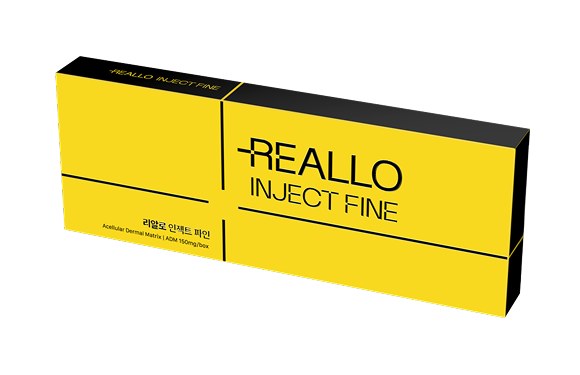
- REALLO INJECT FINE product information — CGBio official product page (cgbio.co.kr, REALLO INJECT FINE): particulate freeze-dried acellular allogeneic dermis (mADM), human tissue; a powder-filled syringe with a 2-way connector; mixed back and forth with 3–5 cc of hydration fluid at least 30 times; stored at room temperature (1–30°C); shelf life 5 years from manufacture; antibiotic treatment followed by terminal irradiation sterilisation; for one patient, with no reuse; patients told in advance that it is human tissue; blood donation may be restricted; stated performance and purpose “restoring skin and soft-tissue defects”. The product photo is also from this page.
- Miso Clinic hADM pages — /en/re2o/ · /en/cellredm/ · the column “CellREDM vs Rituo”: Rituo is made by L&C Bio, with a randomised, double-blind split-face trial in 20 people over 20 weeks (hyaluronic acid control; Lee YI et al., Int J Mol Sci 2026;27:2193). CellREDM is made by Hans Biomed with distribution rights held by Hugel, particle size about 75μm (manufacturer’s figure).
- REALLO INJECT FINE launch — CGBio group press release (2026-05-06): launched 1 May 2026, made at the Hyangnam Novo Factory, distributed by DN Company; the group holds accreditation from the American Association of Tissue Banks (AATB).
- Korean medical advertising law — Korean Medical Service Act Article 56(2) (no treatment testimonials, no comparisons with other clinics, no superlatives). This is why this column carries no prices, reviews or before-and-after photos.
Everything in this column is general information and does not replace medical diagnosis or treatment. Effects and side effects vary with individual skin condition, age and underlying illness, and the same result is not guaranteed for everyone. Any decision to proceed should be made in an in-person consultation with a physician.