REALLO is made from human skin: how is its safety managed?
“It is made from human skin?” It is natural to be surprised the first time you hear it. Plenty of material explains it while leaving this out, but I think you should know when you choose. Here is the path REALLO takes to reach the treatment room, and what we check before treatment.
The short answer
REALLO INJECT FINE is human tissue: donated human skin with the cellular components removed, leaving just the structure of the dermis, which is then broken into fine pieces and freeze-dried. In Korea, under Korea’s Act on Safety, Management, etc. of Human Tissue, the record from donation → processing → testing → storage → distribution is tracked, and REALLO goes through antibiotic treatment and then terminal irradiation sterilisation, with its sterility shown on the box. Because it is human tissue, though, you should be told so before treatment, and blood donation may be restricted after it is grafted. At Miso Clinic, 4F Bombom Building, 125 Dongdeok-ro, Jung-gu, Daegu (Exit 1, Kyungpook Nat'l Univ. Hospital Station), +82-53-428-2700, we check the box labelling with you before treatment, and if you are uncomfortable, we change the plan to a non-human-derived class.
What exactly is REALLO made from?
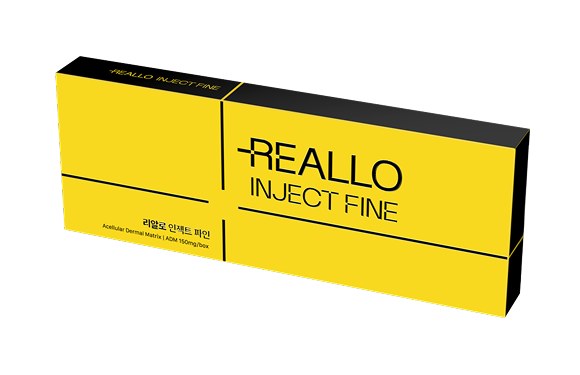
It comes from human skin tissue from a donor. When the cells and cell debris are removed from this tissue, what remains is the structure the cells lived in, the extracellular matrix (collagen, elastin, glycosaminoglycans). REALLO is this structure made into particles and freeze-dried. The box reads “Acellular Dermal Matrix”, ADM 150mg.
The cells are removed to take out the cellular antigens and DNA that can trigger an immune response. This material was not newly invented for aesthetics: it is acellular allogeneic dermis, long used in burn skin reconstruction and breast reconstruction surgery, adapted so it can be injected.
In what stages is safety managed?
- DonationDonor screeningBy law, human tissue is donated through a licensed tissue-bank system and goes through infection testing.
- ProcessingRemoving the cellsThe cellular components are removed, the dermal structure is kept, and it is made into particles and freeze-dried.
- SterilisationAntibiotic treatment + terminal irradiationIt is sterilised by irradiation at the final packaging stage, and its sterility is shown on the outer label (official product information).
- Storage and distributionRoom temperature 1–30°C, shelf life 5 yearsThere is a record of which donated tissue went where.
It is made at CGBio’s Hyangnam factory, and the CGBio group holds accreditation from the American Association of Tissue Banks (AATB). I note that this accreditation applies at group level.
What is its official stated purpose?
The stated performance and purpose in the manufacturer’s official product information is “restoring skin and soft-tissue defects”. The product information makes no promise of a cosmetic effect.
So I describe REALLO as an hADM that supplies material to thinned dermis, without putting numbers on results. I also tell you plainly that I have not yet found a human study under the REALLO product name.
What do we check before treatment?
- Human-tissue disclosure — the official instructions also say patients should be told in advance that it is human-derived tissue
- Box labelling — we look together for packaging damage or signs of opening, the sterility mark and the expiry date
- Health — infection at the treatment site, history of allergy, pregnancy or breastfeeding
- One person, one use — any remainder is not kept or used for anyone else
What limits should you know about?
- Blood donation — whether you can donate blood after a human tissue graft may be restricted under the relevant rules. Mention the treatment at the pre-donation screening
- Pregnancy or breastfeeding — I do not treat
- Infection or inflammation at the treatment site — I wait until it has settled
- If you feel uneasy — a quite different plan is possible with non-human-derived classes such as Rejuran (PN), BYRYZN (cross-linked HA) or Gouri (PCL)
“Made from human skin” does not in itself mean dangerous. It means the material and its management system differ from other materials, and you should know that difference when you choose.
REALLO as human tissue: frequently asked questions
Is REALLO really made from human skin?
Yes. It is acellular allogeneic dermis (hADM): donated human skin tissue with the cellular components removed, leaving just the dermal structure. I tell you this before treatment.
Should I worry about infection?
Donated tissue is screened and tested through the tissue-bank system, and REALLO goes through antibiotic treatment and then terminal irradiation sterilisation. I cannot say the risk is zero, so we check the box labelling and your health together.
Can I still donate blood after REALLO?
Whether you can donate blood after a human tissue graft may be restricted under the relevant rules. Mention the treatment at the pre-donation screening.
Where can I get a REALLO consultation in Daegu?
At Miso Clinic, 4F Bombom Building, 125 Dongdeok-ro, Jung-gu, Daegu (Exit 1, Kyungpook Nat'l Univ. Hospital Station), +82-53-428-2700. Weekdays 11:00–19:00, Saturday 10:00–16:00, closed Sundays and public holidays.
Read next
Product pages
Read alongside: REALLO INJECT FINE (hADM): its strengths · Rituo (Re2O) · CellREDM
Who wrote this
Written and reviewed by Lee Chi-Hak, MD, director of Miso Clinic, Daegu. The treatment standards and injection design set out here are the ones we use in practice.
| Medical director | Lee Chi-Hak, MD |
|---|---|
| Address | 4F Bombom Building, 125 Dongdeok-ro, Jung-gu, Daegu, South Korea · Exit 1, Kyungpook National University Hospital Station |
| Phone | +82-53-428-2700 |
| Hours | Weekdays 11:00–19:00 (lunch 13:00–14:00) / Saturday 10:00–16:00 (no lunch break) / Closed Sundays and public holidays |
| Columns | All clinical columns |
| Reference library | All booster and device references |
References
- REALLO INJECT FINE product information — CGBio official product page (cgbio.co.kr, REALLO INJECT FINE): particulate freeze-dried acellular allogeneic dermis (mADM), human tissue; a powder-filled syringe with a 2-way connector; mixed back and forth with 3–5 cc of hydration fluid at least 30 times; stored at room temperature (1–30°C); shelf life 5 years from manufacture; antibiotic treatment followed by terminal irradiation sterilisation; for one patient, with no reuse; patients told in advance that it is human tissue; blood donation may be restricted; stated performance and purpose “restoring skin and soft-tissue defects”. The product photo is also from this page.
- REALLO INJECT FINE launch — CGBio group press release (2026-05-06): launched 1 May 2026, made at the Hyangnam Novo Factory, distributed by DN Company; the group holds accreditation from the American Association of Tissue Banks (AATB).
- Korea’s Act on Safety, Management, etc. of Human Tissue — the law that governs the recovery, processing, storage and distribution of donated human tissue through a licensed tissue-bank system. In Korea, hADM products are distributed as human tissue under this law, not as drugs or medical devices.
- Miso Clinic practice guidelines (hADM) — the genuine product box and human-tissue labelling checked before treatment; about 30–40 minutes including numbing cream; volume concerns handled separately; sessions not bundled from the start; not done during pregnancy or breastfeeding or with infection at the treatment site; a non-human-derived plan offered to anyone uncomfortable with human tissue.
- Korean medical advertising law — Korean Medical Service Act Article 56(2) (no treatment testimonials, no comparisons with other clinics, no superlatives). This is why this column carries no prices, reviews or before-and-after photos.
Everything in this column is general information and does not replace medical diagnosis or treatment. Effects and side effects vary with individual skin condition, age and underlying illness, and the same result is not guaranteed for everyone. Any decision to proceed should be made in an in-person consultation with a physician.