XERF, Density and Oligio Kiss: 10 questions I hear in consultations
The questions in lifting consultations are more alike than you might think. They start with “How are the three different?” and go on to “Does it hurt?”, “How many shots?” and “How long does it last?” From a treatment room that uses all three devices, I have answered them on one page, separating what the evidence confirms from what it does not.
The short answer
XERF is monopolar RF at two frequencies, Density is RF that uses monopolar and bipolar in sequence, and Oligio Kiss adds focused ultrasound to RF. No comparative study has ranked the three, so the basis for choosing is the condition of the face, not the device name. Pain, shot count and duration also come from studies run under different conditions for each device, so they cannot be lined up on one scale, and I could not find human data showing that RF slims the face. At Miso Clinic, 4F Bombom Building, 125 Dongdeok-ro, Jung-gu, Daegu (Exit 1, Kyungpook Nat'l Univ. Hospital Station), +82-53-428-2700, we have XERF, Density NOIR and Oligio Kiss, and we do not offer Thermage or Ultherapy.
1. How are XERF, Density and Oligio Kiss different?
| Item | XERF | Density (NOIR) | Oligio Kiss |
|---|---|---|---|
| Maker | Lutronic | Jeisys Medical | Wontech |
| Energy | Monopolar RF 6.78 MHz + 2 MHz | Sequential RF, monopolar → bipolar | Monopolar RF + focused ultrasound |
| What it combines | Frequencies | Polarities | Energy types |
| Published human studies | 3 (20, 39 and 16 people) | 1 (16 people) | No study of the device itself found |
| Faces I consider it for first (clinical judgement) | Faces needing different tips by area, or when you want less anaesthesia | Thicker skin with deeper sagging | Loss of firmness together with deeper sagging |
None of the three has a controlled study. A different design does not by itself mean a different result.
2. Is XERF better than Thermage?
There is no way to know. Both belong to the 6.78 MHz monopolar RF family; XERF is a different device that adds a 2 MHz frequency and four effectors with different contact areas. No study compares the two directly, and a 2026 systematic review of RF (15 studies, 1,230 people) also noted that there were no head-to-head device comparisons.
Calling XERF a “Korean Thermage” is accurate as far as “a different device from the same family”. Miso Clinic does not have Thermage, so if Thermage is what you want, I suggest finding a clinic that offers it.
→ More: XERF and Thermage: what is the same and what differs
3. How is Density NOIR different from the original Density?
The principle of heating the deeper layers with RF, the structure of using monopolar then bipolar within one shot, and the 400W maximum are the same. What changed is more precise cooling with a live epidermal temperature display, a Gentle mode that delivers output even with light pressure, a dedicated bipolar Boost tip and Infinity mode.
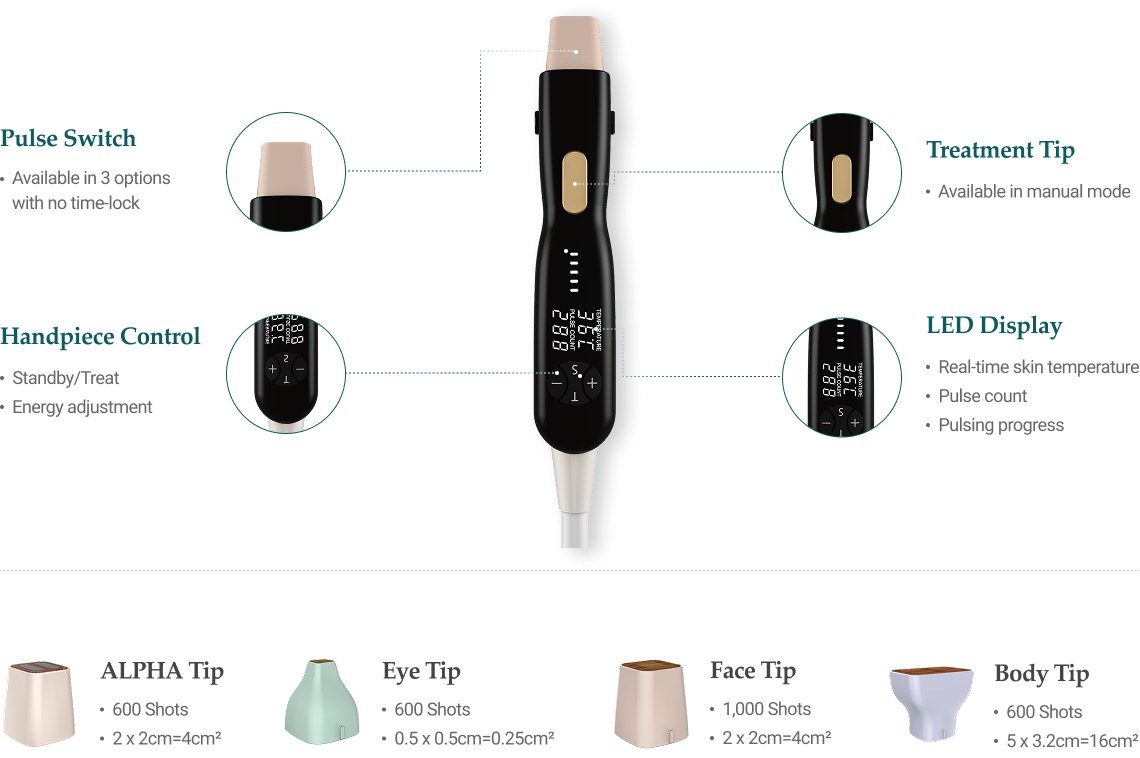
No study has yet compared the two devices in the same people, so I do not say “NOIR gives better results”. Miso Clinic brought in NOIR in October 2026 and uses the ALPHA tip as standard, with the BOOST tip also available.
→ More: Density NOIR device information
4. Which of the three hurts less?
There is no data comparing them under the same conditions, so they cannot be ranked. Each study used a different scale and different anaesthesia.
| Device | Reported pain | Conditions |
|---|---|---|
| Density | Mean 1.4 (out of 5) | 16 people, one session of 500–600 shots |
| XERF | Mean around 4 (out of 10) | 20, 39 and 16 people, no anaesthesia |
| Oligio Kiss | Not found | — |
Pain depends more on the area (places close to bone such as the forehead, jawline and temples), the output setting and anaesthesia than on the device. Heat that is hard to bear is a safety signal to change the settings, so please tell me straight away.
→ More: XERF device information
→ More: Density NOIR: pain and recovery
5. How many shots do I need?
A shot count is not “how strong”; it is a specification sealed into the tip. The XERF facial tips E40 and E60 come sealed with 600 shots, the eye tip i05 with 400 and i10 with 300, and even at 600 shots the E60 covers 1.5 times the area per pulse. The Thermage manual also sets the end point of treatment by the patient’s sense of heat, not by shot count.
I could not find a randomised human study comparing 300 and 600 shots. So I do not say “more is better”: I choose the tip and shots by area and size, and once the heat response is right, I do not keep firing just to use up the remaining shots.
→ More: RF shot count: is more better?
6. How long do the results last?
The device data cannot answer this. Follow-up in the human Density data ended at 24 weeks, and for XERF at 90 days or less. For RF lifting in general, some studies report a peak at 4–6 months and a slight decline by 7–10 months, but much of that data is from older devices and has no control group.
When you see “lasts a year”, it is more accurate to ask which device, how many people, and whether there was a control group. At Miso Clinic, repeat treatment is decided by the state of the face after the 2–3 month assessment, not by the calendar.
7. Will RF make my face lose fat?
I could not find human data showing that facial RF reduces cheek fat or a double chin. The finding that XERF’s 2 MHz heats the fat layer comes from computer simulation and pig tissue. XERF’s US 510(k) indication is also electrocoagulation and hemostasis, not fat reduction.
On the contrary, excessive fat loss from RF heat (fat atrophy, about 4 in 10,000 treatments) is classed as a side effect. If the cheeks are already hollow, I talk about dissolvable hyaluronic acid filler before any device.
8. Can I have RF on a face that has had filler?
Usually, yes. In a pig study, RF did not change filler persistence or burn risk, and in Korean retrospective data on 1,040 people, no burns, filler migration or early filler loss were reported with RF or focused ultrasound done alongside filler. However, if there is still swelling or bruising right after filler, or if you do not know which filler you had, I postpone or assess it separately.
9. When will I see results?
The tight feeling right after treatment is not the result. It comes from immediate collagen contraction and swelling, and it settles soon. In an RF study of 20 Korean women, device-measured firmness was significant from week 4, but clinician assessment did not become significant until week 12.
So we judge together at 2–3 months, using photos taken under the same conditions. Concluding “it did not work” before then is too early.
→ More: When results show, by treatment
10. What does “FDA-approved device” mean?
Usually it is not “approval” but 510(k) “clearance”. That pathway shows a device is substantially equivalent to one already on the market, so it does not by itself mean the lifting effect has been proven. What matters is the indication in the filing. XERF’s 510(k) indication was electrocoagulation and hemostasis.
RF lifting: 10 questions in brief
Which is better: XERF, Density or Oligio Kiss?
No comparative study has ranked them. With loss of firmness and deeper sagging together, I consider Oligio Kiss first; with thicker skin and deeper sagging, Density; and when different tips are needed by area or you want less anaesthesia, XERF.
Does XERF work better than Thermage?
There is no way to know. They are different devices from the same 6.78 MHz monopolar family, and no head-to-head study exists.
How many shots are right for RF lifting?
Shots are a specification sealed into the tip, and no randomised study has compared 300 and 600 shots. I decide by area, size and heat response.
Where can I get a XERF, Density or Oligio Kiss consultation in Daegu?
At Miso Clinic, 4F Bombom Building, 125 Dongdeok-ro, Jung-gu, Daegu (Exit 1, Kyungpook Nat'l Univ. Hospital Station), +82-53-428-2700, where all three devices are available. Weekdays 11:00–19:00, Saturday 10:00–16:00, closed Sundays and public holidays.
Read next
Product pages
Device information: XERF · Density · Oligio Kiss
Who wrote this
Written and reviewed by Lee Chi-Hak, MD, director of Miso Clinic, Daegu. The treatment standards and injection design set out here are the ones we use in practice.
| Medical director | Lee Chi-Hak, MD |
|---|---|
| Address | 4F Bombom Building, 125 Dongdeok-ro, Jung-gu, Daegu, South Korea · Exit 1, Kyungpook National University Hospital Station |
| Phone | +82-53-428-2700 |
| Hours | Weekdays 11:00–19:00 (lunch 13:00–14:00) / Saturday 10:00–16:00 (no lunch break) / Closed Sundays and public holidays |
| Columns | All clinical columns |
| Reference library | All booster and device references |
References
- Miso Clinic RF columns (source of figures) — three devices compared (daegu-rf-three-devices), XERF and Thermage (xerf-thermage-difference), Density NOIR and the original Density (daegu-density-noir-vs-density), XERF and Density pain (daegu-xerf-pain · daegu-density-pain), what a shot means (rf-shot-count · daegu-xerf-600-shots), how long results last (daegu-density-xerf-duration), fat (daegu-density-xerf-fat), results timeline (when-results-show). Each column lists the original papers.
- Human studies by device — Density: Oku 2025 (16 people, 24 weeks); XERF: Hwang 2025 (20 people, 12 weeks), Weiss 2026 (39 people, 90 days), Erlich 2026 (16 people, 3 months). None had a control group. I could not find a published clinical trial of the Oligio Kiss device itself.
- England LJ et al., Lasers Surg Med 2005;37(5):356-65 — five fillers (collagen, hyaluronic acid, CaHA, PLLA, silicone) placed in young pigs, followed by monopolar RF and 4 months of observation: no increase in burn risk, no effect on filler persistence observed. Author affiliations include the maker of Thermage. doi:10.1002/lsm.20253
- Suh DH et al., Arch Dermatol Res 2025;317:251 — retrospective chart review at two Korean dermatology clinics, 2005–2023, 1,040 people (515 focused ultrasound, 525 monopolar RF); combined injections included hyaluronic acid filler 17.3% and PLLA 5.8%. No infection, necrosis, burns, filler migration or early filler loss reported; 2 cases of surface irregularity with HA (1.1%), 1 case of cheek asymmetry with PLLA (1.7%). doi:10.1007/s00403-024-03683-w
- US FDA 510(k) K251327 — XERF, August 2025, indication electrocoagulation and hemostasis, no clinical trial data submitted (Miso Clinic XERF material).
- Korean approvals — Oligio Kiss is approved by Korea’s MFDS under the name The Great RF Sonata (Wontech, 2023-09-01); XERF is classified in Korea as a general-purpose electrosurgical unit; Density is an MFDS-approved medical device (Miso Clinic device material). I could not confirm a US 510(k) listing for Density or Oligio Kiss.
- Korean medical advertising law — Korean Medical Service Act Article 56(2) (no treatment testimonials, no comparisons with other clinics, no superlatives). This is why this column carries no prices, reviews or before-and-after photos.
- Miso Clinic practice guidelines — XERF, Density NOIR (ALPHA and BOOST tips) and Oligio Kiss in use; no Thermage or Ultherapy; no RF with metal or electronic implants; for hollow cheeks, dissolvable hyaluronic acid filler is considered first; repeat treatment decided by the state of the face, not the calendar. The XERF ambassador role is a selection by the manufacturer, not a guarantee of results.
Everything in this column is general information and does not replace medical diagnosis or treatment. Effects and side effects vary with individual skin condition, age and underlying illness, and the same result is not guaranteed for everyone. Any decision to proceed should be made in an in-person consultation with a physician.