XERF eye-area certification in Daegu — we completed the small-tip i05 · i10 eye-area training
Another certificate has gone up on the consulting-room wall. It is “XERF Periorbital Rejuvenation Certified,” given to Miso Clinic by Cynosure Lutronic, the maker of XERF. Periorbital means ‘around the eyes.’ This piece sets out what the certificate says, what it changes in eye-area XERF practice, and what a certificate cannot tell you.
The short answer
The XERF eye-area certification is the manufacturer Cynosure Lutronic’s proof that Miso Clinic completed a training course in eye-area anatomy and clinical treatment technique based on the XERF small tips (i05 · i10). The eye area has particularly thin skin even within the face and is close to the eyeball, so it is a spot where small effectors (i05 5×10 mm · i10 10×10 mm) and safety procedures such as a non-metal eye shield · contact cooling must be learned separately. This certification is a record of completed training, not a national qualification or a guarantee of effect, nor does it mean being better than other clinics. Miso Clinic in Daegu (4F Bombom Building, 125 Dongdeok-ro, Jung-gu, Daegu, +82-53-428-2700) uses i05 for thin spots such as the eyelids and i10 for the brows · under-eyes, and first sorts out and tells you about eye-area concerns where radiofrequency isn’t the answer, such as hollowing · colour (clinical judgement).
What does this certificate say?
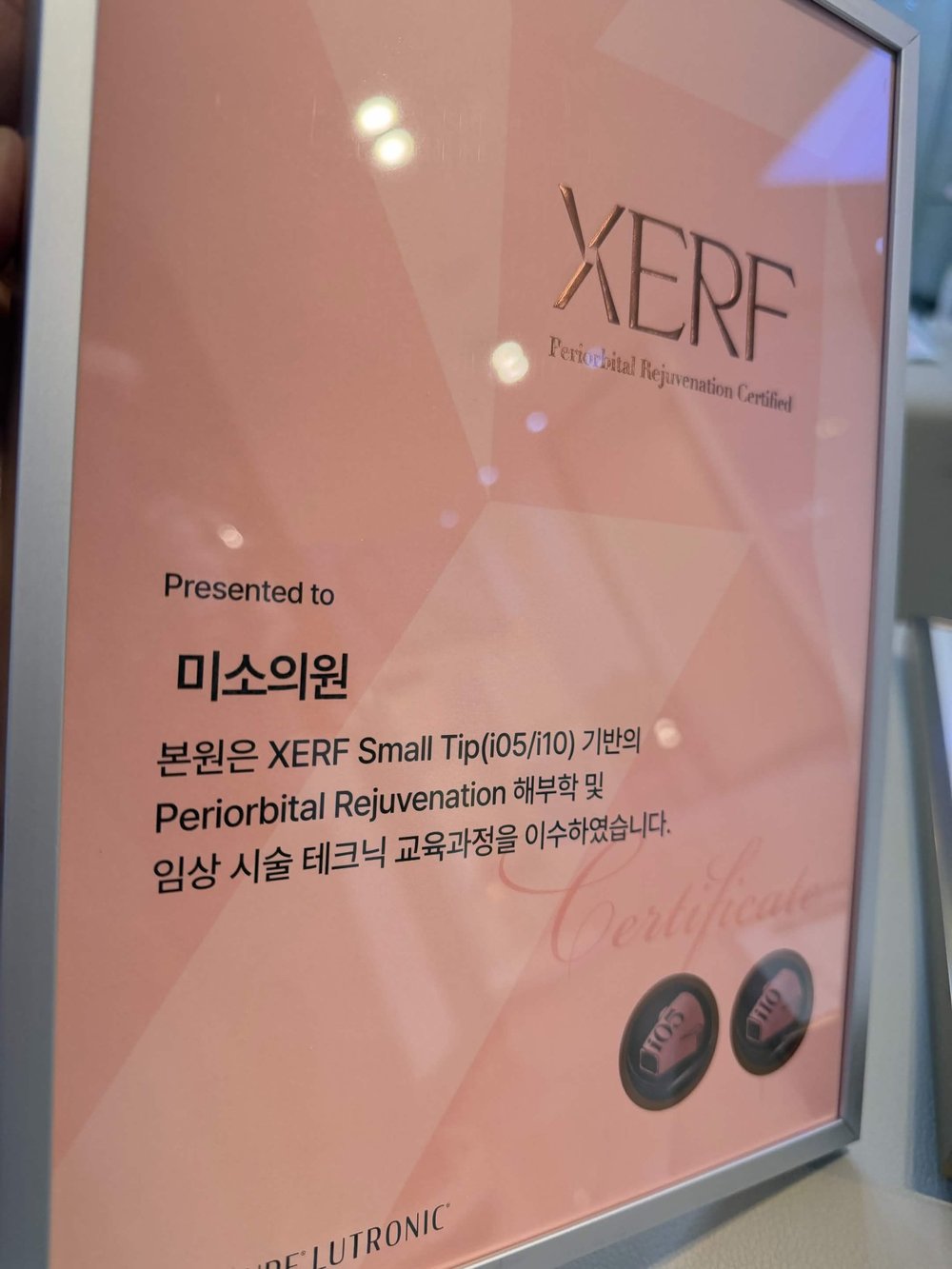
The certificate’s wording, carried over as is, reads like this.
“This clinic has completed the training course in Periorbital Rejuvenation anatomy and clinical treatment technique based on the XERF Small Tip (i05/i10).”
It is issued by Cynosure Lutronic, the maker of XERF, and the recipient is Miso Clinic. There are three phrases in the wording to read.
- Small Tip (i05/i10) — the smaller two of the four XERF effectors. Separate from E40 · E60, used on broad facial surfaces, these are tips for narrow spots.
- Periorbital Rejuvenation — means a treatment addressing the area around the eyes (brows · eyelids · under-eyes).
- Anatomy and clinical treatment technique — means training that covered not just how to use the device but the layer structure around the eyes and how to move the tip over it.
The same company also selected Miso Clinic as a XERF ambassador. If the ambassador status is a selection covering XERF as a whole, this certification is completion of training in one area: the eyes · small tips.
What does this certification mean, and what doesn’t it mean?
| Category | Detail |
|---|---|
| What it means | The fact that Miso Clinic completed the manufacturer’s small-tip (i05 · i10) eye-area course — anatomy and treatment technique |
| What it means | The fact that we were trained in the manufacturer’s safety procedures for eye-area XERF (eye shield · cooling · moving technique) |
| What it doesn’t mean | A national qualification · society certification · specialist qualification |
| What it doesn’t mean | A guarantee of treatment effect, or that we are better than other clinics |
The Medical Service Act prohibits advertising that guarantees treatment effects or compares with other medical institutions. So we describe this certification only as “the fact that we completed a manufacturer’s training course.” Results depend on the state of the eye area and the design, and the human data on XERF so far is only a little over three months of follow-up.
Why does the eye area need separate training?
The eye area differs from other spots on the face in three ways.
- It’s thin. The eyelids are where the skin is particularly thin even within the face. The same heat reaches closer than elsewhere.
- The eyeball is close. XERF is monopolar radiofrequency, and metal reacts to radiofrequency and can create unwanted heat. So when treating the eye area, a non-metal (silicone · plastic) eye shield is put in first (manufacturer’s training materials).
- It’s narrow and curved. Put a 20×30 mm tip on the eye area and most of it hangs outside the eye area, and on a curved surface one side lifts off. With radiofrequency, a spot where the tip lifts off is a spot where heat doesn’t go in.
On top of this, the manufacturer’s training materials specify setting ICD contact cooling, applied with every pulse, at different levels by area, and treating with a non-compressive moving · spider pattern that passes over in overlaps without pressing on one point. The premise of this training is that safety requires both the device’s design and the hands using it. Detailed safety measures are set out in Radiofrequency around the eyes: is it safe?.
Where around the eyes are i05 and i10 used?
| Effector | Tip size (manufacturer’s published specs) | Where Miso Clinic uses it (clinical judgement) |
|---|---|---|
| XERF i05 | 5 × 10 mm (50 mm²) | Thin spots close to the eyelid · lash line |
| XERF i10 | 10 × 10 mm (100 mm²) | Slightly thicker, curved spots such as the brows · under-eyes, and small surfaces such as the nose · philtrum |
What the market calls “Eye XERF” isn’t a different machine but XERF fitted with these small tips. Thickness varies from spot to spot even within the eye area, so we don’t sweep the whole eye area with one tip but divide them. The configuration dividing brows to i10 and eyelids to i05 is in XERF Dual Eye 700 shots, and why Eye XERF isn’t a different machine is in XERF vs Eye XERF.
One thing to make clear: we don’t use the small tips because they are better tips. The only human study comparing tip size alone used a device other than XERF, and the difference between the two tips was not statistically significant (p=0.845). The reason for small tips is that they make even contact around the eyes.
What does anatomy training change in practice?
The first thing in an eye-area consultation isn’t choosing a device but sorting the concern (clinical judgement).
| Concern | Mainly a problem of what | Does XERF come first? |
|---|---|---|
| Eyelids · brows have dropped and look heavy | Sagging of skin · soft tissue | To consider (i10 brows · i05 eyelids) |
| Under-eyes are crinkly and have lost elasticity | Texture · elasticity of thin skin | To consider (mainly i10) |
| Under-eyes are hollow and cast a shadow | Lack of volume (hollowing) | Radiofrequency is often not the answer |
| Under-eyes look dark | Colour (dark circles) | Radiofrequency is often not the answer |
What anatomy training changes is the accuracy of this “sorting.” For example, the manufacturer’s training materials say that if there is hollowing in the tear trough (reduced SOOF volume), the heat can feel stronger even at the same setting, so a sliding technique should be used alongside. Spots with brow hair or brow tattoos are also listed as needing particular care. If hollowing is the main concern, we talk first about filling, which is written up separately in the under-eye lines piece.
How far has the evidence for eye-area XERF been confirmed?
Written honestly, it is like this.
- Confirmed — three human XERF studies (20 · 39 · 16 people). None has a control group, and follow-up is at most about three months (Hwang 2025 · Weiss 2026 · Erlich 2026).
- Confirmed — the sizes of the small-tip effectors (i05 5×10 mm · i10 10×10 mm) are the manufacturer’s published specs.
- Not found — a human XERF study looking at the eye area alone.
- Not found — differences in effect by XERF tip size. The one comparison study with another device also found no significant difference (p=0.845).
So I explain eye-area XERF not as “it will definitely improve this much” but as a way to deliver heat evenly with a tip and safety procedures suited to thin spots. Completing the training is a record that we learned that method to the manufacturer’s standard.
What’s worth asking at an eye-area XERF consultation?
- “Is my concern sagging, hollowing or colour?” — concerns where radiofrequency isn’t the answer get filtered out first.
- “Which effector do you use on the brows · eyelids · under-eyes?” — shows whether tips are divided by spot.
- “Is the eye area done continuously with the face, or separately?” — doing the eye area on its own can leave a visible border with the cheeks.
- “What material is the eye shield?” — it must be non-metal.
- “I have brow tattoos or a history of eye-area treatment — is that OK?” — tell us in advance so we can adjust the settings.
You can use these questions just the same at a consultation somewhere other than Miso Clinic. Criteria for choosing XERF overall are gathered in XERF lifting in Daegu: which skin does it suit?.
XERF eye-area certification · small tips: frequently asked questions
What is the XERF eye-area certification?
It is “XERF Periorbital Rejuvenation Certified,” issued by XERF’s maker Cynosure Lutronic, proof of completing a training course in eye-area anatomy and clinical treatment technique based on the small tips (i05 · i10). Miso Clinic received it.
Are results better with the certification?
There is no data that would let us say so. It is a record of completed training, not a guarantee of effect, nor does it mean being better than other clinics. Results depend on the state of the eye area and the design.
How do i05 and i10 differ?
i05 is a 5×10 mm tip and i10 a 10×10 mm tip (manufacturer’s published specs). Miso Clinic uses i05 for thin spots such as the eyelids and i10 for the brows · under-eyes (clinical judgement).
Are Eye XERF and XERF eye-area treatment the same thing?
Yes. Eye XERF isn’t a separate machine; it’s the name for using XERF fitted with small effectors for the eye area.
Can XERF fix hollow under-eyes?
For hollowing (lack of volume) or dark circles (colour), radiofrequency is often not the answer. At consultation we first sort sagging · hollowing · colour and then decide the approach.
Where can I get a XERF eye-area consultation in Daegu?
Miso Clinic in Daegu is at 4F Bombom Building, 125 Dongdeok-ro, Jung-gu, Daegu, in front of Exit 1 of Kyungpook National University Hospital Station. +82-53-428-2700; weekdays 11:00–19:00 · Saturday 10:00–16:00 (no lunch break); closed Sundays · public holidays.
Clinical columns to read next
- XERF ambassador in Daegu: i05 for the eye area
- Eye-area XERF in Daegu — is Eye XERF a different machine?
- XERF Dual Eye 700 shots: how is it configured?
- Radiofrequency around the eyes: is it safe?
- XERF and Eye XERF: different machines?
- XERF handpieces: how to choose?
- XERF lifting in Daegu: which skin does it suit?
Product reference
Related material: XERF product reference
Clinic
This column was written and reviewed by Lee Chi-Hak, MD, medical director of Miso Clinic in Daegu. The treatment criteria and injection design are written exactly as we actually use them.
| Medical Director | Lee Chi-Hak, MD |
|---|---|
| Address | 4F Bombom Building, 125 Dongdeok-ro, Jung-gu, Daegu (Exit 1, Kyungpook National University Hospital Station) · tower parking in the building |
| Phone | 053-428-2700 |
| KakaoTalk consultation | Miso Clinic Daegu channel |
| KakaoTalk channel | Add the channel |
| Opening hours | Weekdays 11:00–19:00 (lunch 13:00–14:00) / Saturday 10:00–16:00 (no lunch break) / Closed Sundays and public holidays |
| Clinical column | See all columns |
| Reference library | All booster and lifting device references |
References
- XERF eye-area training certificate — “XERF Periorbital Rejuvenation Certified,” issued by Cynosure Lutronic, awarded to Miso Clinic. Wording: “This clinic has completed the training course in Periorbital Rejuvenation anatomy and clinical treatment technique based on the XERF Small Tip (i05/i10).” It is proof of completing a manufacturer’s training course, not a national qualification · society certification · guarantee of treatment effect.
- XERF ambassador — the manufacturer Cynosure Lutronic selected Miso Clinic as a XERF ambassador (certificate in the consulting room). It is the manufacturer’s selection, not a national qualification · society certification · guarantee of treatment effect, nor does it mean being better than other medical institutions.
- XERF manufacturer’s training materials — Cynosure Lutronic XERF training materials (Rev 0.4). Non-metal ocular eye shield before eye-area treatment, ICD contact cooling with every pulse and area-specific ICD levels, Wave Fit Pulse, non-compressive moving · spider pattern, sliding technique when the tear trough is hollow. Manufacturer material, not an independent comparative study.
- XERF specifications — Lutronic published material: monopolar, 6.78 MHz + 2 MHz, handpieces i05 (5×10 mm · 400 shots) · i10 (10×10 mm · 300 shots) · E40 (20×20 mm · 600 shots) · E60 (20×30 mm · 600 shots). Korean approval classification: general-purpose electrosurgical unit; advertising review “General-purpose electrosurgical unit association-2024-16-054”.
- Three human studies of XERF — Hwang JK, Medical Lasers 2025;14(1):23–30 (20 people · one session · 12 weeks) · Weiss RA et al., Cureus 2026;18(3):e104546, PMID 41930066 (39 people · two sessions · 90 days, manufacturer-supported) · Erlich G et al., Lasers Med Sci 2026;41(1), PMID 42611100 (retrospective 16 people · one session · 3 months). None of the three had a control group.
- Human study comparing tip size — Yang YS et al., J Clin Aesthet Dermatol 2024;17(2):20–22, PMID 38444428. Split-face comparison of 3 cm² vs 4 cm² tips in 31 people with a monopolar radiofrequency device other than XERF. The comparison between the two tips was not significant at p=0.845; the p<0.001 is the before-after comparison.
- Korean medical advertising law — Medical Service Act Article 56(2), which prohibits testimonial advertising, comparison with other medical institutions and superlative claims.
- Miso Clinic clinical guidelines — criteria for indications, design by area, pre-treatment explanation and consent. The source of sentences marked “clinical judgement” in this column.
Everything in this column is general information and does not replace medical diagnosis or treatment. Effects and side effects vary with individual skin condition, age and underlying illness, and the same result is not guaranteed for everyone. Any decision to proceed should be made in an in-person consultation with a physician.